GE Multilin: Frequently Asked Questions

GE Multilin has been around since 1995. This part of General Electric focuses on industrial controls and manufacturing relays. This includes flexible process bus solutions and dual and multi-feeder protection for industrial applications. It also includes integrated motor protection for medium/large induction and synchronous motors.
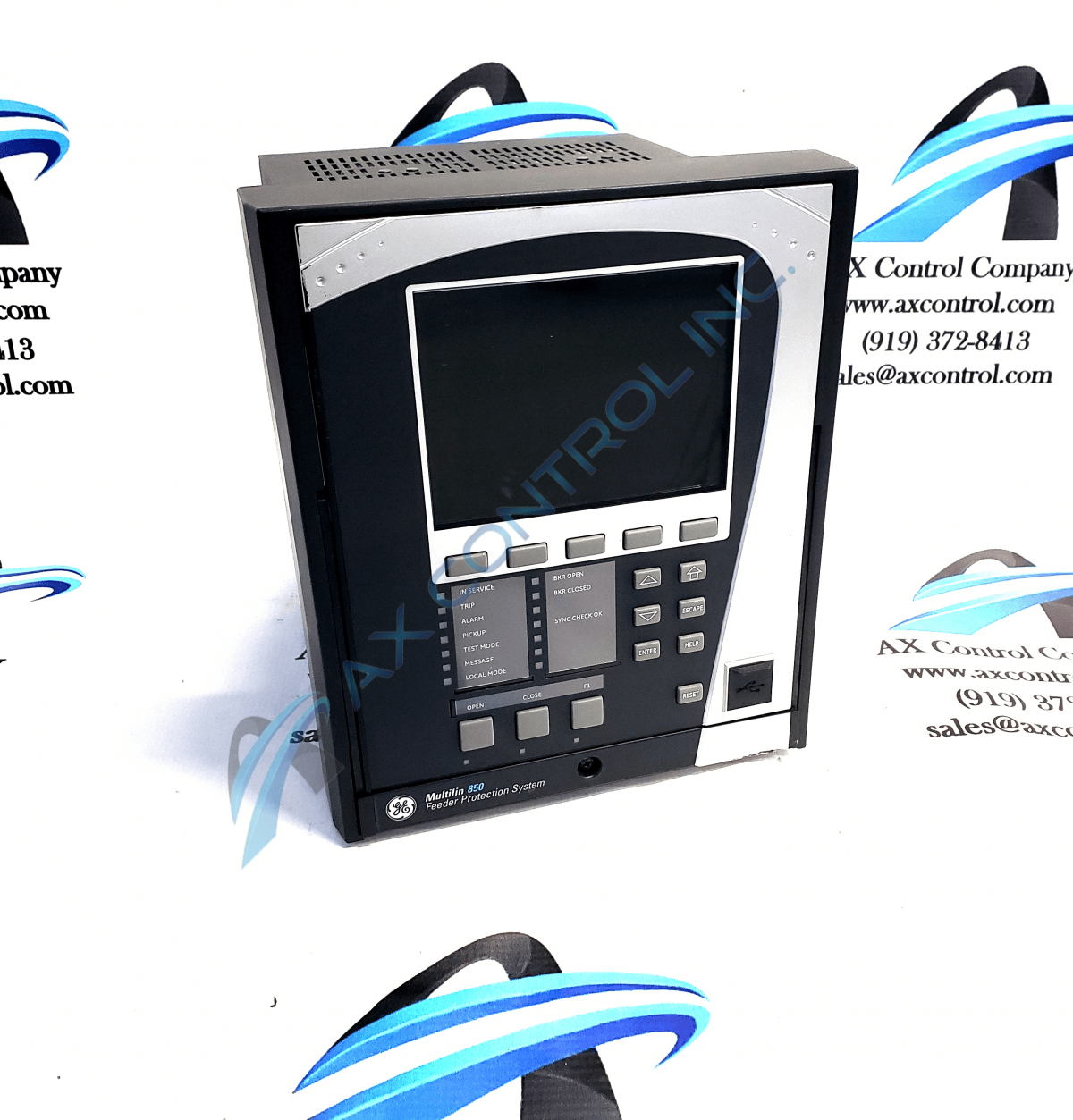
Closeup of a GE Multilin 850 Feeder Relay
GE Multilin 850 Feeder Protection Relay (850-EP5NNG5HNNAANGAPFCSENNBN)

What is a Multilin Relay?

Industrial motors, feeder systems, transformers, and generators can use Multilin relays. These management relays protect while offering advanced monitoring functions.

GE Multilin is part of GE Grid Solutions. GE Grid Solutions is the renewable energy subsidiary of GE. It offers products and technology for control, metering, and communication. It is applicable for industrial, commercial, and transportation applications.

How are GE Multilin Relays used?

Many industries make use of GE Multilin relays. For example, utilities use the 850 Feeder protection system to ensure continuity within the power grid. Small and medium-sized distribution transformers, also part of the power grid, use the Multilin 350 feeder protection series.

Additionally, distributed generation interconnect protection and bus blocking often use the 750/760 Feeder management system. The 489 Generator Management Relay design protects and controls small to medium-sized generators. Moreover, the 369 and 469 Motor management relays offer management and protection to three-phase medium (369 AC only), and large (469 only) HP motors and driven equipment.

What are the benefits of Multilin Relays?

Multilin relays must stand up to rugged industrial standards. Most have front panel displays for viewing and programming in the field as well as RS232/RS485 ports to network and download data. Front panel LEDs are easy to read and the front keypad makes it simple to toggle through values and fault diagnosis information, as well as to set new data points.

A note about the FM2 Multilin and resetting trips

The FM2 Feeder series has a reset key that will allow a tripped state to be reset. However, earth faults or thermal overloads cannot be reset using this key. But the Lockout Reset feature will assign a fault to the programmable switch inputs. Overriding this lockout can occur through the lockout reset interlock.

How do I program my GE Multilin or update firmware?

GE is great about providing technical help to its users. There are over 100 Multilin videos on the gegridsolutions.com website covering everything from how to update the firmware to how to set a transient recorder. These videos are available in French, Spanish, Portuguese, English, and sometimes Russian.

AX Control carries a wide variety of GE Multilin products, including the GE Multilin 750.
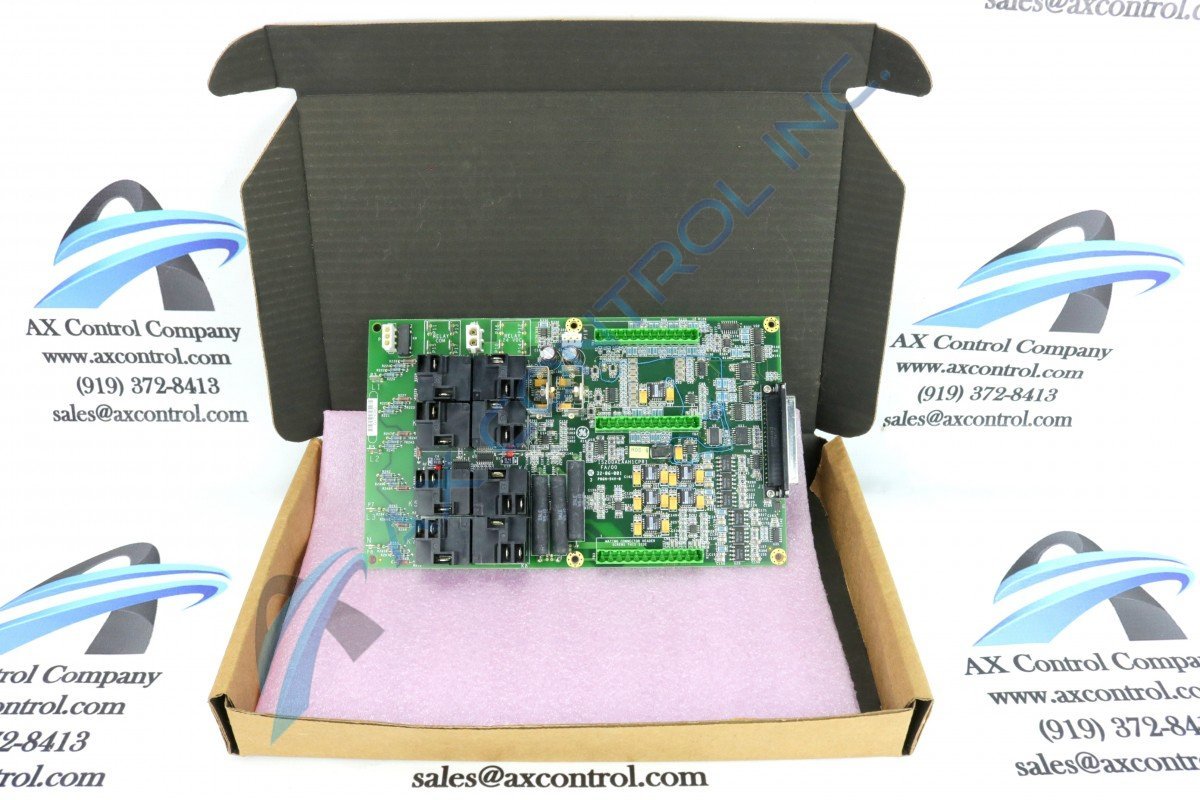
Understanding Speedtronic Mark VI and Mark VIe Part Numbers

When working with any legacy system it’s important to understand naming conventions of the part numbers and how those part numbers may have changed through various part runs. AX Control sells many legacy systems, including several of the Speedtronic series like the Mark I-II, Mark IV, the Mark V, as well as the Speedtronic Mark VI and Mark VIe series boards.

When we look at GE’s Speedtronic Mark VI and Mark VIe as an example, we can see how this works. They have designed their part number so it gives the user a significant amount of information–if you know how to break down that information properly. Let’s look at one example.

An IS200AEAAH1CPR1 board from GE's MKVI Speedtronic line for gas and steam turbine control.
The IS200AEAAH1CPR1 Mark VI Turbine Control Card, available on AXControl.com

If we take the above IS200AEAAH1CPR1 board, we can break the number down into several different parts that will each tell us something about the board: IS/2/00/AEAA/H/1/C/PR1

Continue reading “Understanding Speedtronic Mark VI and Mark VIe Part Numbers”

A History of GE Speedtronic Turbine Control

GE has a long history of providing industrial control systems for gas and steam turbines.

Speedtronic turbine control from General Electric is one of the world’s most reliable turbine control systems. Find out more below.

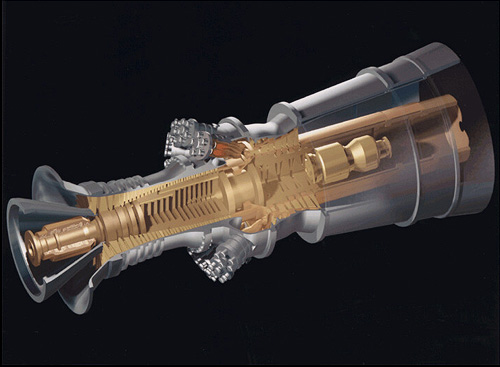
GE Industrial Gas turbine cross section
Cross-section of a GE industrial gas turbine

A History of Turbine Science

Gas turbine theory is not new to the world; in fact, Leonardo Da Vinci designed a reaction-type turbine. While nothing like the turbines of today, Da Vinci’s chimney jack’ used hot air rising from a hearth to turn an axial rotor attached to a roasting spit located over the fire. In this way, food on the spit turned without need for an attendant, harnessing the power of burning gases.

Early History

 GE was one of the first modern companies to understand the power of turbine applications. High-profile projects like Niagara Falls (1918) and the Grand Coulee Dam project (1942) used GE turbines. The first gas turbine used to generate electric power in the US came from General Electric. It was a 3.5-MW unit installed at Belle Isle Station, Oklahoma City, OK, in 1949.

Expansion of Products

GE’s gas turbine division is now over a century old. It has advanced gas turbine jet engine design along with commercializing industrial gas turbines for the first time. GE turbines are also used for power generation. You can find them in nuclear power plants, combined-cycle gas turbine plants, and in steam turbine systems and boiler systems.

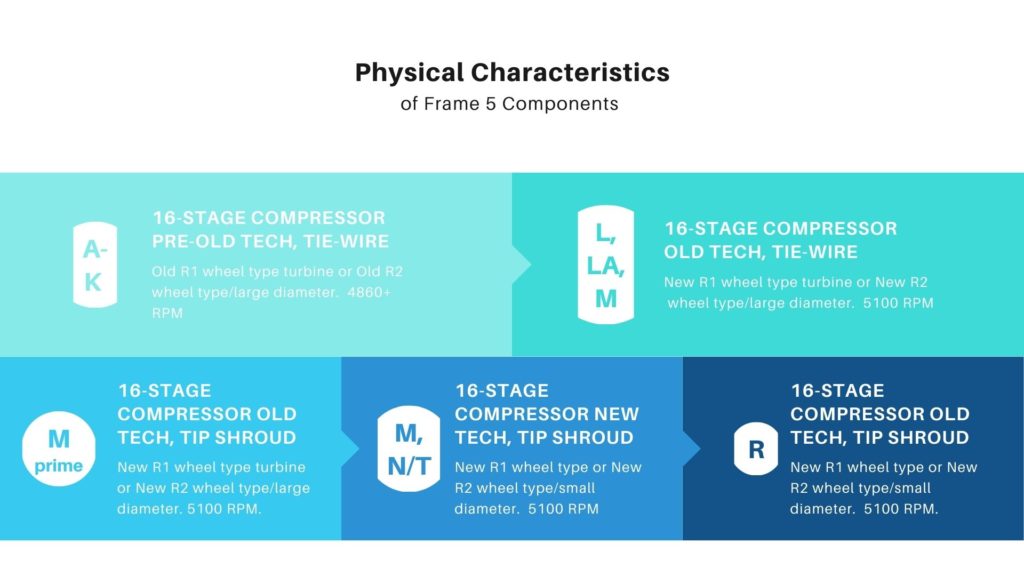
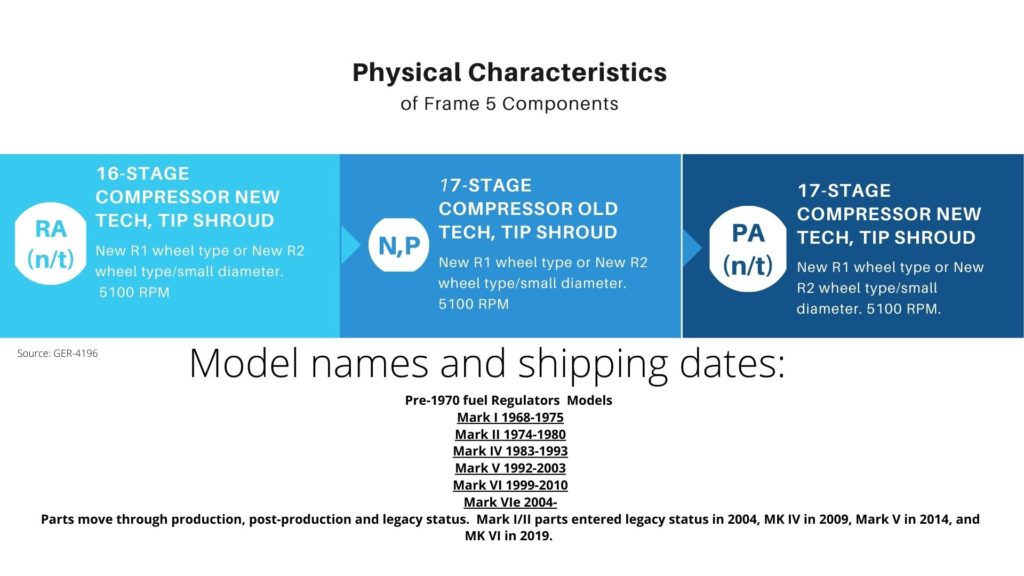
Graphic explaining GE Frame 5 Turbine Characteristics
Graphic explaining physical characteristics of GE Frame 5 components. Includes Models and shipping dates of Speedtronic series.
Download a high quality pdf of these characteristics.

Introduction of Speedtronic Turbine Control

Beginning in the 1960s and continuing through the early 2000s, GE developed and sold sophisticated turbine control systems for their gas and steam turbines. These systems sold under the SPEEDTRONIC trademark name. Speedtronic systems started with the Mark I series, continuing through the release of the Mark VIe.

While each system had significant improvements, many Mark I and Mark II control systems are still in active use around the world today.  The longevity of these systems is attibutable to GE’s adherence to specific gas and steam turbine control philosophies. These emphasize “safety of operation, reliability, flexibility, maintainability, and ease of use, in that order,” according to company documents. The gas philosophy maintains: 

Continue reading “A History of GE Speedtronic Turbine Control”