
The Winding History of Rockwell Automation

Rockwell Automation is one of the biggest industrial automation companies in the world. But a little over a century ago it began as a small company devoted to one product started on a $1,000 investment.

The infographic below will give you many of the highlights, but the company has continually grown through other beneficial acquisitions,mergers, and divestitures as well. This includes

  • Allen-Bradley’s acquisition of Robotronics S.A. from Matra S.A. in 1985. Robotronics S.A. was active in robot vision. (1)
  • Allen-Bradley’s acquisition of the Electronics Corporation of America in 1986 for $99 million. The Electronics Corporation of America was based in Waltham, Mass. and manufactured electronic combustion sensors and photoelectric controls. (2)
  • Allen-Bradley’s acquisition of Creonics in 1990. Creonics created motion control products (3)
  • Allen-Bradley’s acquisition and partnership with Metal Leve Controles Eletronicos in 1992 The company specialized in electromechanical industrial control products. (4)
  • Rockwell’s acquisition of Reliance Electric for 1.6 billion dollars in 1994. The company focused on motors, drives, and mechanical drive components. Rockwell also buys ICOM and Controlware around this time. (5,6,7)
  • Rockwell International acquisition of California’s Intecolor Corp in 1997. The privately held company, which built high-performance computer monitors and industrial workstations, was purchased for an undisclosed amount. (8)
  • Rockwell’s acquisitions of Dynapro and EJA Engineering in 1999. Dynapro designed HMI interface software, while EJA specialized in industrial Automation safety components. (9,10)
  • Rockwell’s acquisition of several software companies, including Datasweep in 2005, GEPA in 2006, Incuity in 2008, and ACP in 2016. (11,12,13,14)
  • Rockwell merges Allen-Bradley with Electro-Craft, moving all motion control products under the Allen-Bradley name. (15)
  • Rockwell divested itself of Reliance Electric, selling the power systems business to Baldor Electric in 2006 for $1.75 billion in cash and $50 million in stock. (5)
  • Rockwell’s expansion of its MES (manufacturing execution systems) offerings with the acquisition of Interwave in 2003 and MESTECH Services in 2019. (16,17)
  • Rockwell’s move into advanced technologies with the acquisition of vMonitor in 2013, Jacobs Automation in 2014, Odos Imaging Limited in 2017, Emulate3D in 2019, and AvNet in 2020. (18)
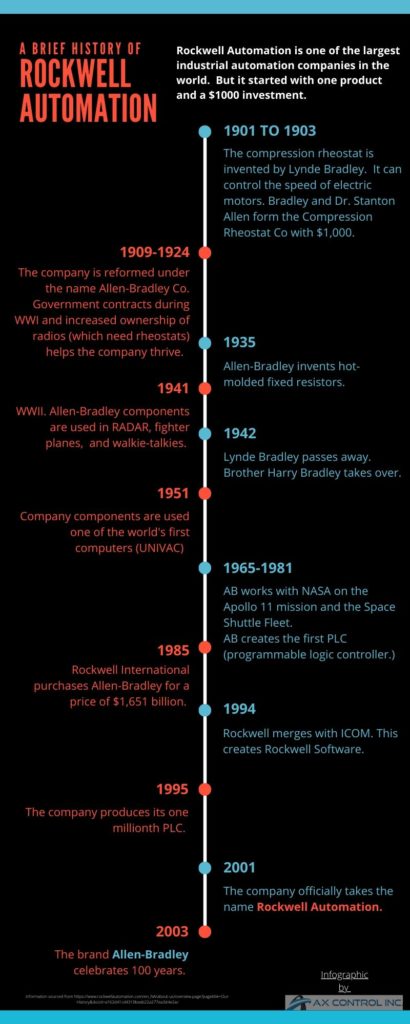
Rockwell Automation
Download a high-quality PDF version of this Infographic below.

For more information on our extensive on-hand Reliance Electric inventory, contact our team or take a look at our website.

Continue reading “The Winding History of Rockwell Automation”
How To Manage Equipment Obsolescence

No one wants expensive unplanned downtime. Here are key steps to avoid it when dealing with obsolete technology.

close up of a toothed gear system.  Such systems may be affected by equipment obsolescence.
No one wants downtime because of equipment obsolescence. Keep those gears turning.

Unplanned downtime due to equipment obsolescence.  

It’s a dirty subject no one wants to talk about. And for good reason.  A 2016 study by the Aberdeen Group put downtime costs across industries at a whopping $260,000 per hour, up 60% from 2014 data.  A 2014 Gartner study was even worse: placing the average cost at $336,000/hour.   One lost eight-hour shift could mean a $2.08 million to $2.68 million loss. 

Regardless of who’s right about the costs, eliminating downtime and disruption is a high priority for most businesses.   Yet more than two-thirds of companies don’t have a full understanding of when their equipment should be maintained, upgraded, or replaced.  

While we’re excited about the future of  Industry 4.0 and IIoT, where every machine can self-analyze its needs and tell you what to do before there’s a problem, we also understand most factories and industrial locations aren’t there yet. They likely won’t be for decades as they continue to operate with older systems in place. 

But old doesn’t mean unusable.  Here’s why. 

Continue reading “How To Manage Equipment Obsolescence”

Infographic: Why IIoT is Essential to Manufacturing

The Industrial Internet of Things (IIoT) has been described as the basis of the coming Fourth Industrial Revolution, otherwise known as Industry 4.0. IIoT is essential to manufacturing. But why? What benefits does the technology bring to the industry?

IIoT brings connectivity, automation, and data analytics to the factory floor. Embedded or attached sensors gather data, which is then used as the basis of analytics and machine learning processes to create a “smart factory.”

Smart factories employ a number of different technologies, including

  • machine learning to analyze data
  • sensors and other monitoring devices to improve production efficiency through real-time decision making
  • integrated robotics that can work alongside human workers

All of these technologies integrate with or rely on IIoT.

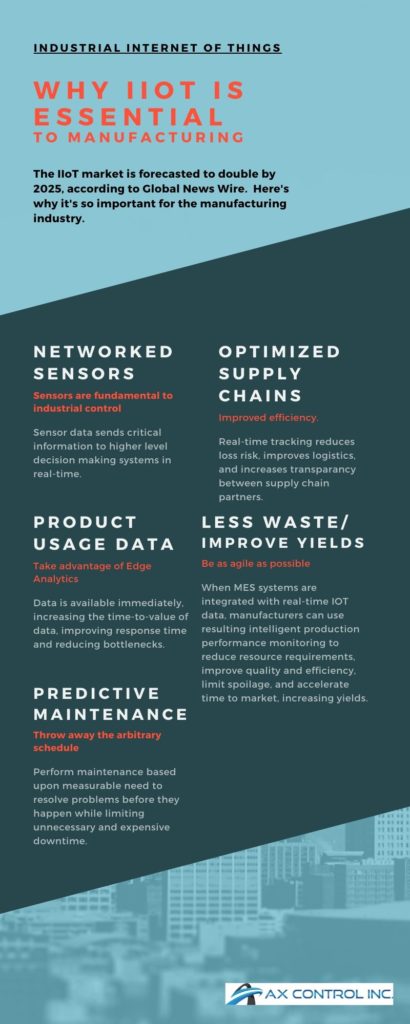
We’ve attached an infographic below to answer the question of what makes IIoT so valuable to manufacturing. If you find it useful, feel free to download and use the high-resolution version available at the end of this article.

Infographic: Why IIoT is Essential to Manufacturing
Why IIoT is Essential to Manufacturing

If you need to know more about how to bring your legacy equipment into the IIoT age, we’ve written about that.

AX Control, Inc provides industrial automation products and repair services to customers around the world.